
A Nantucket Wedding
Everyone comes to the wedding, even if they didn't get an invite.

(An essay from the past. The object of the essay, the married couple, has a son who will be looking at colleges this summer. We measure time in children. If you want to hear me read it in my beautiful whiskey tenor, you’ll have to subscribe)
(Henry Coffin is with The Girl Who Ran the Polpis Road. Click here if you wish to hear it.)
The rain falls on everyone’s weddings these days. I was invited to a recent celebration that had been envisioned out on the cranberry bogs, with a wide open sky and gentle rolling horizon. Instead, the rain faucets came wide open, and we were swept back to the “Where O Where House” for a hastily and tastefully organized ceremony on the back deck. A hundred or so of us were jammed into the little white chairs, tucked into each other’s armpits, while the bride and groom negotiated an aisle with two huge posts in it. Even though the ceremony went off well, it wasn’t the vision of the perfect day the bride and the photographers must have had.
What wedding or marriage is that perfect vision? Ten years down the line, your spouse is much more likely to remember the gaps, missteps, and stinky fingers of the day than all of the flawless ceremony. Marriage, as Rocky said, is all about gaps: “I got gaps, you got gaps. We fill each other’s gaps.”
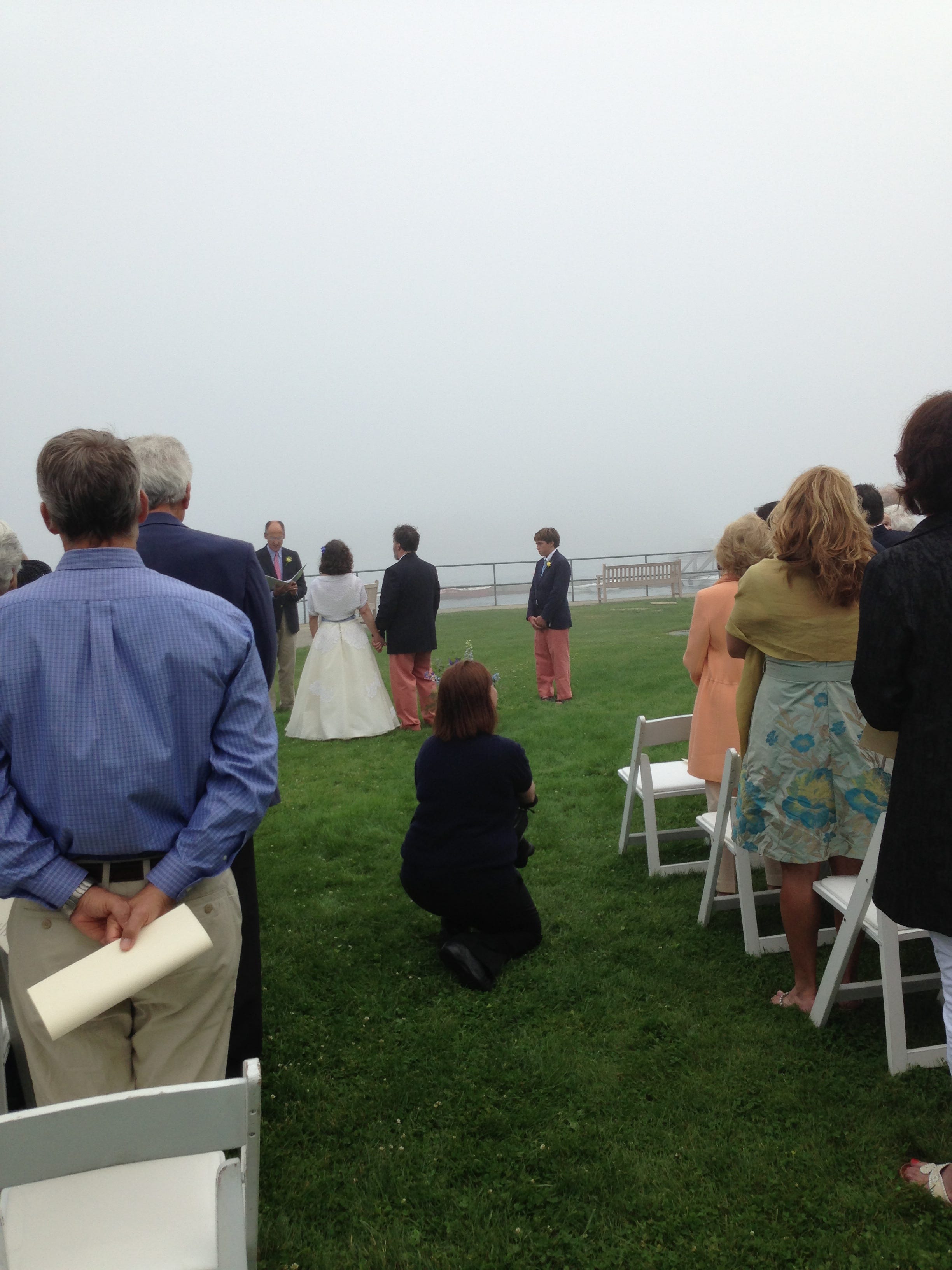
Nantucket weddings have their own peculiar gaps. Fog, wind, and waves interfere with the assembly. You can’t get the right band, the right flowers, or the right food for the right price. However, if you don’t expect too much, you will be surprised by the gifts you do receive. I have heard Ted Anderson opine about the symbolism of the ring for fifteen times, yet it always reverberates in my mind and on my hand. Old friends from far-away places drop in for the ceremony; they tell enough of the story of their lives so that you want to be with them again. Then, they are gone. Inevitably, a guest or two arrives who should have their entrails hanging from the Harbor House ceiling, yet you smile and shake his hand and ask after the Red Sox. For that moment, all of us who were separate are together again on the beach, watching the boat leave.
Weddings bring many new folks onto our beach; for a weekend, they are islanders. In addition to the affection of the wedding, they are romanced by the island. Nantucket is the mother of every island bride; she shapes the event more than any caterer or wedding planner. The guests see the sperm whale’s bones, feel the wind on the moors, eat a striped bass, stand barefoot on the beach, and the Gray Lady pours another intoxicating draft. The wedding guests drink of the silence and the surf, the roses and the romance, the cobblestones and the cranberries, and they go back home with a happy, giddy island buzz, a shot of amour, and a salt-water chaser.
Most weddings have very little to do with the happy couple and everything to do with the guests. The two declare their love and commitment in front of us, so that we can hold their feet to the fire when the going gets tough. But they go and spin out into their lives. For the guests, a wedding brings a reckoning, not only of the bill but of lives. When we see the newlyweds, we see what will be or what was.
Weddings have three different sorts of guests. First, the most energetic guests are the ones who have never been married. They see themselves hopefully transposed onto the central figures, but with a more panache. These are the ones who judge the bridesmaid’s gowns, take pictures of the cake, and remember if the band played “Daddy’s Little Girl” or “Paradise by the Dashboard Lights.” They come to a wedding as shoppers; they try on outfits and practice styles. They also come to the wedding ready to party. To them, a wedding is a celebration of love, alcohol, and friendship. They are easy to find; they are all at the after-party.
Second, most of the guests have already been married. In their bones, they remember the fun and joy of the wedding day, and all of the blood, sweat, toil, and tears that followed it. They also see themselves transposed onto the bride and groom, but they remember how it was for them. They may have been silly, drunk, in love, or amazed, but now, looking back, they knew they were naïve. Marriage is a lot like Nantucket. You come here in the spring or the summer, when the air is warm, the money is easy, and surf is up. Then, the wind changes, everyone leaves, your checks bounce, and the great grey lid comes down. Then it gets worse. Every couple has a dark night in January, when life on the mainland would be a lot easier. Success comes when you decide to stay and wait for June.
Finally, the most important guests won’t arrive and won’t be eating cake. These could be the unborn children that will come a few years downwind. They are unspoken guests in the minds of parents, grandparents, and the couple themselves. In the congregation, someone is not only bearing witness to the union, but doing the familial dihybrid cross. He is adding his height to her athleticism and hoping for a tight end who could actually catch the ball.
The dead are there as well. Aunts, Uncles, Grandfathers, Grandmothers all loom in the background with smiles as the chain moves on through time. Their absence is present in most minds. Everyone takes a sorrowful attendance at weddings and mourns for the empty chairs against the wall. Inevitably, the party has its own members who will slip into that good night before the next wedding comes around. They may be sick, they may be aged, or they may be called off to fight a war in a desert.
The newlyweds float in the center of all of us. Carried on the stream of our good wishes, hopes, and love, they bounce from table to table as if they are riding a leaf in a stream, then spin in circles on the dance floor. As the summer passes and fall arrives, that stream will not so much dry up as “go underground.” The love that springs from their lips and the hope that bangs a fork on a water glass will become the breakfast for two, the made bed, and quiet consideration of passionate friends, traveling through the years wing to wing, and oar to oar.

My polished work is on a new website…. The blog has the “One Good Thing” essays,
Come to Coffin’s Nantucket…click on the picture for all of my writing

The Girl Who Ran the Polpis Road is a reader-supported publication. To receive new posts and support my work, consider becoming a free or paid subscriber.
So, I forget about some essays and I forgot about this one. I remember the occasion well, with the Where o wear house, Ted Anderson, and the couple. The couple have been married for almost 18 years, with two kids and one a year from college. The years hop by like rabbits.