
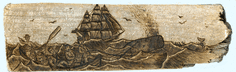
Turf Not Teachers
Nantucket doesn't have a drawbridge, it has a tollbooth

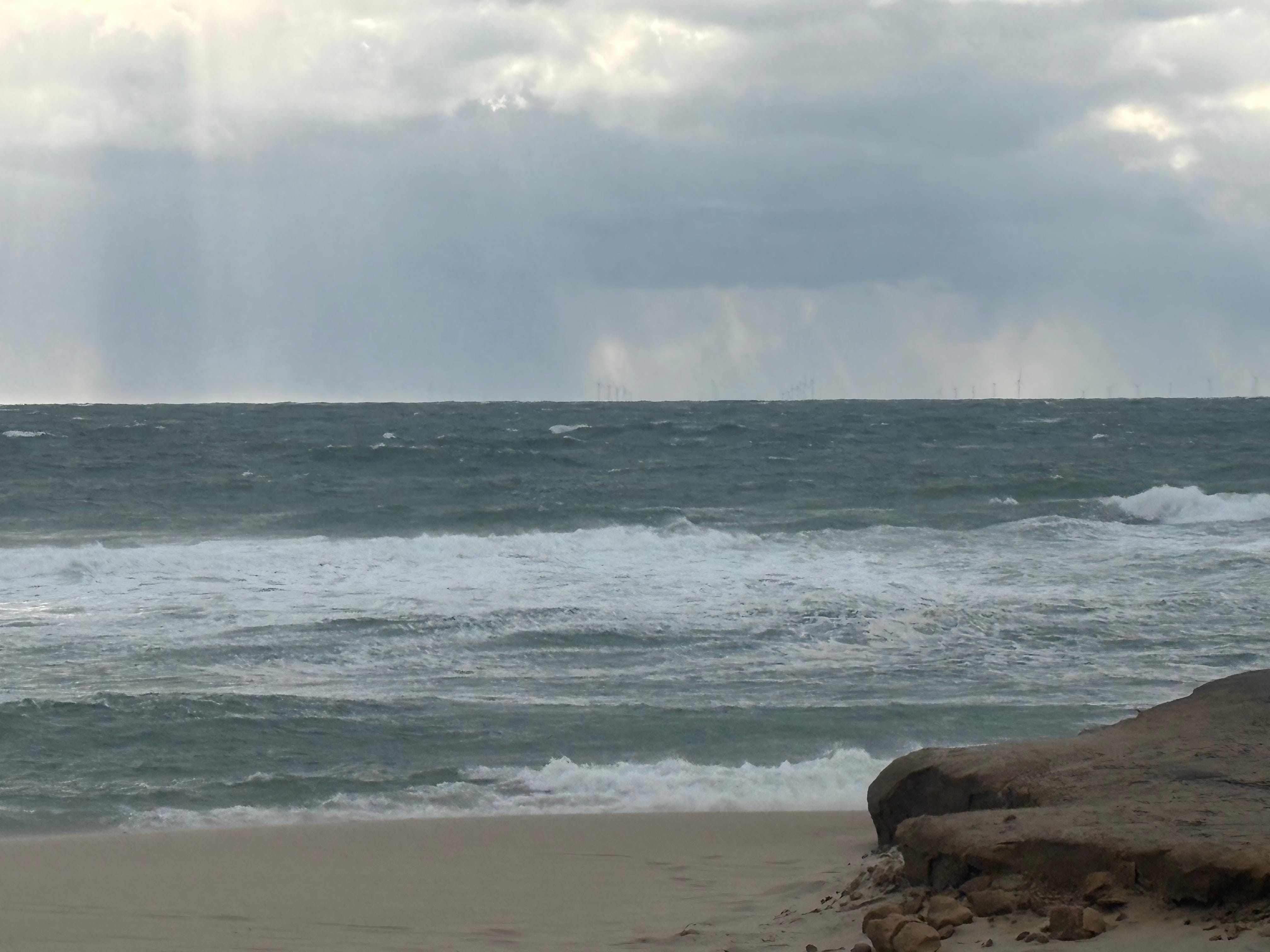
The boats didn’t run today. On this Tuesday, Nantucket stopped being a resort with a moat and returned to being an island in the middle of a rolling, crushing, and indifferent ocean.
A wind-whipped Atlantic does not inspire awe or terror; it exists in a place beyond all that. Mountains tower but are finite; you can see them above you, all the way to the snowy peak. Sublime and awe-inspiring, but the mountain exists in a different place from the warm and snug, where they have cheese soup, focaccia, and a good porter.
There is no warm and snug in an ocean storm. The wind does not sing in stanzas nor does the surf chant in syllables. Gusts hum through the power lines to the chord of the integrals. They shift the house, slip into the gaps, and spin around the rug and furniture. Against the windows, ocean spray and sand spatter the glass in sudden bursts. On the shore, the ten-foot waves back up hundreds of yards from the beach and march andante con brio through the foam, the tide, and the shore. After each wave, the beach survives only to flinch before the wave behind it, and so on without end.
In our warm age, the summer bluffs and the August dunes melt and slide into oblivion. The cliff marks where they were. The ocean doesn’t wait, doesn’t pause, and is immediate to your future. It has a mathematical terror, stretching out to the end of pi. To the horizon, along it, and beyond, the infinite grinds and grabs, day and night, without end or pause. The world will not end in fire, nor in ice, but in a long line of salty waves. The work of a lifetime exists for less than a minute.
Nantucketers in recent years have turned their backs to the sea. Our livelihood is paid on land, not on water. The gas we buy, the Lego sets we wrap, the shows we watch are in a dry and windless world. Go back two generations to the livelihood of the sea; to the fishing boats tied up in the harbor, the freighters crossing on the horizon, the oil tankers in the shipping lanes. We no longer have watches for missing sailors, memorials for boats presumably sunk, or coast guardsmen patrolling the beach for wrecks.
Today, we make our money with backhoes, lawn mowers, and websites. The work is drier, safer, and more lucrative than any done on the ocean. No realtors have been swept overboard this year, nor will many lose their lives that way next year.
Instead, we make fantasies. We pick warm and sunny evenings when we can illuminate all of the rooms of an eight-bedroom house in the long September evening. We summon the fantasy of the friends and family, assembled and joined by the engine of wealth into a pageant of Cisco beer, surf, and silk sheets.
The lonely and rich see the fantasy of green chimneys, the fireplaces, and the charming gardens. In it their families are rejoined in laughter and pleasure, with sand in their toes, drinks in their hands, and a drying beach towel hung out on the split-rail fences. “This,” we sing, “Is what the money is for.”
It works.
The realtor’s ocean is far off, beyond a bluff, winking and welcoming in the sun. It waits for the grandchildren to run into the chill and leap into the waves. Its wordless infinity fills a picture window.
But, as islanders, we have to realize this can only be true on certain days of the year. That image isn’t precisely a lie as it is a partial truth. That same wonderful Sconset house is more likely to be blanketed in fog than warmed by the sun. All of those chimneys were built for a reason.
I fear that we have begun to believe our own bullshit. For many, Nantucket has become exclusive not because of its geology, but its economy. You can only come here if you can buy $18 Bloody Marys, $800 hotel rooms, and 8-million-dollar cottages. Nantucket Sound is no bar for a platinum American Express Card, but it is to a week’s payday. The hallmarks and hardships of island living have been solved by ingenuity and income. Food and fuel arrive by ferry: electricity and the internet come on a cable. We don’t suffer for a lack of milk, wine, or caviar—if you can pay. Some of us may see Nantucket as Manhattan, with better beaches and a steeper cover charge. You don’t need to survive a stormy environment, but you do have to keep your head up in the island economy.
In the last millennia, “Do-gooders” were mocked with a drawbridge. “Do you want to pull up the drawbridge now that you are out here?” In our current times, the bridge still exists, but it has a tollgate on it, where the charge keeps increasing. If you can pay, you can come to Nantucket.
On a Tuesday in late December, when the boats don’t run, the island doesn’t have enough police, firemen, nurses, doctors, garbage men, pizza makers, or postmen. They went home for the holiday; their homes aren’t out here. The tired and tireless middle class can’t live on the island anymore. The union workers and their bosses need to commute.
One of my well-known and well-loved former colleagues is closing in on retirement after many years of puberty and power tools. He has a lovely home. He won’t be giving it to his successor. The next shop teacher better have a trust fund.
I suspect that the good people of Nantucket have figured that housing is someone else’s problem “as long as I get mine.” We feel that somewhere on the island will be a place for teachers to buy, or rent, or live in—everyone has to struggle to live out here. And those workers get paid well. But the problem of housing the helpers has gone into the memory hole with climate change, racism, and imminent asteroid impacts. Bruce Willis saved us from Armageddon; he can handle housing in his spare time.
The school committee must have Bruce’s phone number, because that is the only reason why they could have approved the $25 million for a turf field. If all the needs of the Nantucket School System were culled, and listed by a $500-an-hour consultant, written on poster board, and stuck to a wall, the Vito Capizzo Memorial Astro Carpet would be near the bottom. Surely, we could build dorms for the teachers. Or perhaps build a street with houses that they could rent to own over a thirty-five-year period; “Spend your career with us and we will sell you this house.”
I am not a scientist, nor am I a doctor, nor am I an assistant J.V. field hockey coach. I do know that fog is more of a problem for spring athletes than snow is. I also know that a career in athletic competition, even in the lucrative worldwide women’s field hockey leagues, is far out of the reach of Nantucket athletes. Historically, many more millions of dollars have been earned by Nantucket graduates who became doctors, lawyers, engineers, and teachers than was earned by native professional athletes. No house on Nantucket was built by a Nantucket athlete with her athletic winnings. The Vito Capizzo Memorial Astro Turf Carpet makes about as much sense as the Richard Bretschneider Snow Making and Aerial Park at Dead Horse Valley.
In the last ten years, the Town Fathers have become children waiting in line for Santa. They have a wishlist that they want Santa Billionaire to bring to town meeting. Or perhaps, to the elves in the Land Bank will send them a present. They don’t seem to worry about what the town can afford to pay for as much as they wish for Cash Kringle to write a check. The billionaires know whether you have been good or bad, so be good for goodness’ sake.
Meanwhile, the ocean laughs.
Nantucket is not Manhattan; it is more like Monhegan. We are twenty-eight miles out to sea, beyond the horizon. The ocean rips us away from the world. The success of the island relies on us because on a stormy day we are the ones that wake up here. If our future as a community relies exclusively on the Scudder’s high-speed bridge and bar service, we will be giving up fire, police, schools, and hospitals. The island helpers need to have a home here, not in Mashpee.
Some of my writing…
Barr’s For Life: A substack of essays and claptrap
The Boat at the End of Lover’s Lane
(NEW) The Girl Who Ran the Polpis Road
The Inn on Brant Point (Novella)
Her Lover on Monomoy Road. (Novella)
Her Father Came Home to Deacon’s Way (Novella)
Winter: A Collection of Island Living Essays set between January and April 1.
Autumn: Essays about Nantucket in Autumn.
Holidays: Essays about the holidays in November and September
The Boys: A collection of essays about my two sons, written as they grew.
Rolling in the Surf: Essays on Teaching.

Barr’d for Life is a reader-supported publication. To receive new posts and support my work, consider becoming a free or paid subscriber.
Thanks for the comments. I have a larger gripe with the Town Fathers than the football field. Nobody is planning for more than next summer. Decisions are being made pay check, to paycheck, not decade to decade. 25 million here,350 million there, pretty soon you are talking about real money. And we are rap[idly losing teachers cops, and firemen with mortgages and long term interest out here. If we are thinking of the Nantucket Experience and don't care about community, we can probably find some temps for all of this. But I don't think we do.
And where would we put them?
I had one other flippant thought. On South Shore Road, on the way to the sewer beds, a real estate speculator is trying to sell an eight bedroom house. It has parking garages, a pool, and a fire pit. It would make a lovely dorm for teachers. The house could probably get bought for 25 million.